
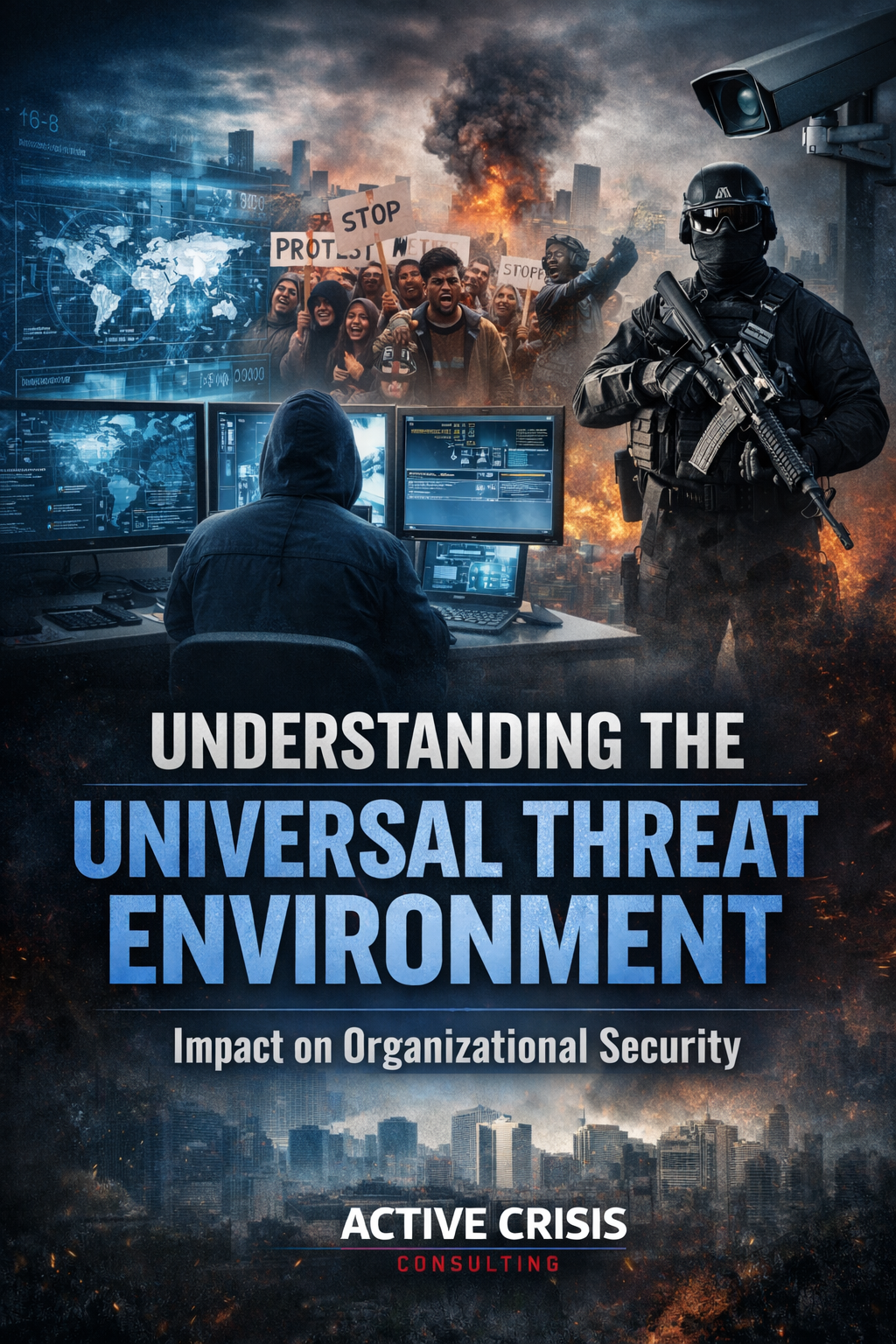
Organizations today do not operate in isolation. They function within what security experts describe as a universal threat environment — a constantly shifting landscape of physical, digital, ideological, and insider risks.
The universal threat environment reflects interconnected vulnerabilities that affect every facility regardless of size or industry.
Active Crisis Consulting emphasizes that understanding this environment is foundational before conducting a facility security assessment.
What Is the Universal Threat Environment?
The universal threat environment describes:
- The totality of global risk trends
- Social, political, and economic instability
- Technology-enabled threat actors
- Radicalization patterns
- Insider threat evolution
It recognizes that no facility exists outside broader societal forces.
Why It Matters to Facility Security
A facility security assessment must be grounded in awareness of the universal threat environment.
Before implementing mitigation strategies, organizations should conduct a professional facility security assessment to understand site-specific vulnerabilities.
Drivers of the Universal Threat Environment
- Rapid Technology Access
- Ideological Polarization
- Social Media Amplification
- Economic Disruption
- Infrastructure Interdependence
These forces create unpredictable flashpoints.
Structural Forces Reshaping the Universal Threat Environment
The universal threat environment is not simply the result of isolated incidents. It is shaped by deep structural forces that influence how threats emerge, evolve, and spread.
Understanding these forces allows organizations to anticipate risk rather than react to it.
1. Acceleration of Information
Information now travels globally in seconds. Social media platforms amplify grievances, misinformation, and extremist narratives at unprecedented speed. This rapid dissemination contributes to:
- Copycat incidents
- Coordinated flash-mob style disruptions
- Rapid radicalization cycles
- Real-time targeting of organizations
The universal threat environment is therefore not linear. It is networked and self-reinforcing.
Active Crisis emphasizes that organizations must monitor narrative trends alongside physical vulnerabilities. A facility security assessment without contextual intelligence is incomplete.
2. Blurring of Physical and Digital Domains
Threats are no longer purely physical or purely cyber. They are hybrid.
Examples include:
- Cyber reconnaissance preceding physical breach
- Data leaks leading to targeted harassment
- Digital doxxing followed by physical confrontation
- Disruption of access control through network intrusion
In this blended threat model, physical security teams must coordinate with cybersecurity leadership.
Active Crisis Consulting incorporates cross-domain analysis into its security planning methodology. Organizations operating within the universal threat environment must recognize that a digital weakness may create physical exposure.
3. Decentralized Threat Actors
Unlike traditional organized groups, many modern threat actors operate independently. They self-radicalize, self-train, and self-deploy.
This decentralization makes detection more difficult.
There is often:
- No formal command structure
- Minimal communication footprint
- Limited warning indicators
This unpredictability increases the importance of behavioral awareness training and recurring facility security assessment updates.
4. Erosion of Traditional Warning Signals
Historically, organizations relied on observable escalation patterns before violent incidents. Today, those signals may be compressed or hidden.
Shorter planning cycles mean organizations may have limited time to respond once intent becomes visible.
Active crisis planning therefore requires proactive vulnerability mapping — not reactive threat tracking.
Sector-Specific Implications of the Universal Threat Environment
The universal threat environment affects industries differently, but none are immune.
Corporate Campuses
Corporate facilities face risks including:
- Workplace violence
- Ideologically motivated protests
- Insider intellectual property theft
- Targeted harassment
Security teams must combine threat intelligence with operational readiness.
Healthcare Facilities
Hospitals and clinics are particularly vulnerable due to:
- Open access policies
- Emotional volatility among visitors
- High-value equipment
- Cyber-physical integration
Active Crisis Consulting frequently advises healthcare organizations to conduct recurring facility security assessments due to their unique exposure profile.
Educational Institutions
Schools and universities operate within one of the most sensitive segments of the universal threat environment.
Challenges include:
- Open campus design
- Large transient populations
- Emotional escalation among students
- Social media–driven conflicts
Understanding evasion tactics is especially important in educational environments, where adversaries may attempt to blend into crowds.
Industrial and Infrastructure Sites
Critical infrastructure facilities face risks including:
- Sabotage
- Insider collusion
- Surveillance probing
- Coordinated access disruption
Here, the universal threat environment intersects directly with national security concerns.
Psychological Drivers Within the Universal Threat Environment
Security is not purely mechanical. It is behavioral.
The universal threat environment is fueled by:
- Grievance-based motivation
- Perceived injustice
- Ideological identity
- Personal crisis
- Fame-seeking behavior
Organizations must train personnel to recognize pre-incident indicators such as:
- Fixation on security weaknesses
- Repeated boundary testing
- Aggressive grievance articulation
- Escalating hostility
Active Crisis integrates behavioral threat indicators into its consulting methodology to reduce blind spots.
Intelligence Integration and Continuous Monitoring
A static understanding of the universal threat environment quickly becomes outdated.
Organizations must implement:
- Threat intelligence briefings
- Regional trend monitoring
- Law enforcement liaison coordination
- Periodic risk re-evaluation
A facility security assessment conducted once and never revisited loses value in a dynamic environment.
Active Crisis Consulting supports clients through recurring strategic reviews aligned with emerging intelligence.
Operationalizing Awareness
Awareness alone does not create resilience. It must translate into action.
Within the universal threat environment, operationalization includes:
- Updating access control protocols
- Refining visitor verification procedures
- Enhancing surveillance analytics
- Running tabletop exercises
- Testing emergency communication redundancies
Security leaders must ensure that policy adjustments reflect evolving adversary capabilities.
The Cost of Complacency
Organizations that underestimate the universal threat environment often rely on outdated assumptions such as:
- “It won’t happen here.”
- “We are too small to be targeted.”
- “Our industry is low risk.”
These assumptions create exposure.
Modern threat actors frequently target soft environments precisely because they appear unprepared.
Active Crisis reinforces that resilience is proportional to preparation.
Building Adaptive Security Architecture
Adaptive security architecture acknowledges that:
- Threats evolve
- Tactics change
- Motivations shift
- Technology advances
Therefore, protective strategy must remain flexible.
A comprehensive facility security assessment provides the baseline. Ongoing active crisis consulting ensures adaptation.
Together, they create a layered defense structure that responds to changes within the universal threat environment rather than remaining static.
Leadership Responsibility in a Universal Threat Environment
Executives must:
- Allocate appropriate budget
- Demand measurable security metrics
- Require recurring assessments
- Support behavioral awareness initiatives
Security cannot function effectively without leadership sponsorship.
Organizations that embed threat awareness into governance cycles outperform those that treat security as peripheral.
Strategic Takeaway
The universal threat environment is not a temporary phase. It is the defining operational reality of modern organizations.
Understanding it requires:
- Contextual intelligence
- Structured assessment
- Behavioral awareness
- Leadership commitment
- Adaptive planning
Active Crisis and Active Crisis Consulting position organizations to move from uncertainty to informed resilience.
Security today is not about reacting to yesterday’s incident.
It is about anticipating tomorrow’s risk.
Adversary Adaptability
Threat actors continuously refine evasion tactics to exploit gaps in physical and procedural defenses.
Explore how modern evasion tactics are used to bypass conventional safeguards.
The Psychological Component
Understanding motivation matters. The universal threat environment is influenced by grievance-based violence, copycat phenomena, and ideological radicalization.
Active Crisis Consulting integrates behavioral threat intelligence into security planning.
Strategic Implications for Leadership
Leaders must:
- Monitor emerging risk signals
- Integrate intelligence into planning
- Conduct recurring assessments
- Train personnel
Security must be proactive.
Organizations should also review federal threat reporting and behavioral analysis resources to stay aligned with national intelligence trends. The FBI’s official crime and threat data publications provide valuable context for understanding patterns within the broader universal threat environment.
The universal threat environment demands adaptive security strategy. Organizations that ignore global threat trends leave themselves exposed.
Through structured analysis, facility security assessment, and proactive active crisis consulting, resilience becomes measurable and manageable.


