
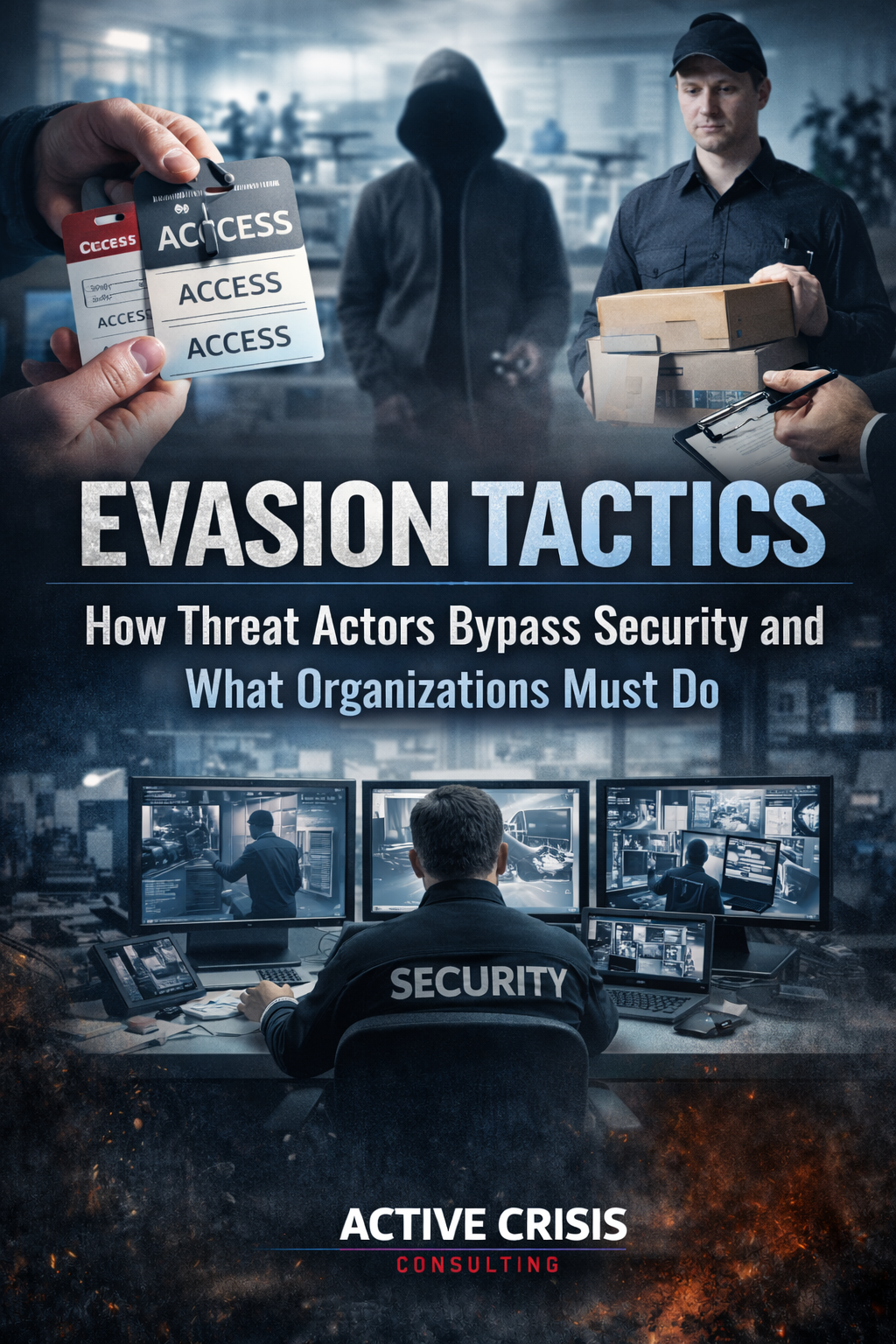
Modern attackers rarely rely on brute force alone. Instead, they deploy calculated evasion tactics designed to bypass safeguards undetected.
Understanding evasion tactics is critical in today’s universal threat environment.
Active Crisis Consulting integrates evasion modeling into every facility security assessment.
What Are Evasion Tactics?
Evasion tactics are methods used by adversaries to:
- Avoid detection
- Exploit blind spots
- Manipulate human behavior
- Circumvent technology
Common Evasion Tactics Used Today
- Tailgating
- Social Engineering
- Disguise and Impersonation
- Surveillance Probing
- Delivery Deception
- Credential Cloning
The Strategic Evolution of Evasion Tactics
Evasion tactics are not random. They evolve in response to security improvements. Every time organizations upgrade technology, adversaries adapt behavior.
This constant adaptation is shaped by the broader universal threat environment, where information spreads quickly and attack methods are openly analyzed online.
Modern threat actors study:
- Security camera placement patterns
- Badge access protocols
- Guard shift rotations
- Delivery intake procedures
- Emergency response times
In many cases, they conduct low-level probing before any major action occurs.
This probing may appear harmless — a visitor asking detailed access questions, someone repeatedly testing locked doors, or a contractor attempting badge bypass. Yet these small interactions often represent deliberate reconnaissance.
Active crisis planning requires recognizing that evasion begins long before an overt incident.
Layered Evasion: How Threat Actors Combine Techniques
Rarely does a threat actor rely on a single tactic. Instead, they layer multiple evasion tactics together to increase success probability.
For example:
- Social engineering to gain employee trust
- Surveillance probing to identify blind spots
- Tailgating to bypass access control
- Insider manipulation to sustain access
This layered methodology increases complexity and reduces detection likelihood.
A professional facility security assessment examines how these tactics might intersect. It does not evaluate weaknesses in isolation but studies how vulnerabilities compound under pressure.
Active Crisis Consulting emphasizes adversary pathway modeling — mapping how a determined individual could move through a facility using realistic evasion scenarios.
Technology Exploitation as an Evasion Tool
Organizations often assume technology provides sufficient protection. However, technology itself can be exploited.
Examples include:
- Overreliance on badge systems without behavioral oversight
- Cameras installed without real-time monitoring
- Alarms triggered so frequently that they are ignored
- Automated access systems lacking redundancy
Evasion tactics frequently exploit human complacency around technology.
If a camera exists but is rarely reviewed, it becomes a psychological deterrent rather than a practical defense.
Within the universal threat environment, adversaries understand this gap. They exploit not the absence of security, but the predictability of it.
Insider-Enabled Evasion
One of the most dangerous forms of evasion tactics involves insider assistance.
This may include:
- Credential sharing
- Security protocol leaks
- Deliberate blind-eye behavior
- Contractor collusion
Insider-enabled evasion is especially difficult to detect because it leverages legitimate access.
A thorough facility security assessment must evaluate insider risk exposure, access privilege segmentation, and monitoring controls.
Active Crisis Consulting integrates behavioral threat indicators and privilege auditing into its assessment process to reduce insider vulnerability.
Psychological Manipulation as a Core Evasion Method
Many evasion tactics rely on exploiting human psychology rather than defeating technology.
Common psychological levers include:
- Authority (impersonating supervisors or officials)
- Urgency (creating artificial time pressure)
- Familiarity (posing as a known vendor or contractor)
- Sympathy (feigning distress)
Security personnel and employees must be trained to recognize these behavioral manipulations.
Without awareness training, even sophisticated facilities remain vulnerable.
Active crisis strategy requires empowering personnel to question anomalies without fear of overreaction.
Red Team Testing and Controlled Evasion Simulations
One of the most effective ways to measure vulnerability to evasion tactics is through controlled testing.
Red team exercises simulate real adversary behavior in a structured environment.
These simulations may test:
- Tailgating resistance
- Reception screening discipline
- Delivery verification processes
- Badge cloning detection
- After-hours perimeter integrity
Active Crisis frequently incorporates controlled scenario testing into facility security assessment programs. These exercises provide measurable insight into how personnel respond under realistic pressure.
Organizations seeking additional federal guidance on protective security measures and infrastructure resilience can review resources provided by the Cybersecurity and Infrastructure Security Agency (CISA), which outlines national best practices for physical security planning and risk mitigation.
Evasion Tactics in a Crisis Escalation Scenario
In high-stress events, evasion tactics often accelerate.
For example:
- During a protest, individuals may attempt to blend into crowds.
- During a natural disaster, unauthorized persons may exploit access confusion.
- During a cyber outage, physical access may be temporarily unmonitored.
The universal threat environment includes these destabilizing events that create windows of opportunity for exploitation.
Prepared organizations pre-plan for these crossover risks.
Active Crisis Consulting advises clients to integrate multi-scenario modeling into crisis preparedness programs.
Metrics for Measuring Evasion Resilience
Organizations must move beyond subjective confidence.
Key resilience metrics may include:
- Rate of unauthorized tailgating incidents
- Percentage of verified visitor identification checks
- Response time to suspicious behavior reports
- Frequency of access control audit reviews
- Incident reporting accuracy
A structured facility security assessment establishes baseline metrics. Subsequent reviews measure improvement.
Security must be measurable to be manageable.
Executive Visibility Into Evasion Risk
Evasion tactics represent a governance issue, not merely an operational one.
Boards and executive leadership should receive periodic briefings on:
- Testing results
- Incident trend analysis
- Insider risk indicators
- Access control audit outcomes
Active crisis strategy demands leadership accountability.
When executives understand how evasion tactics expose organizational vulnerability, security shifts from reactive spending to strategic investment.
From Awareness to Adaptive Defense
The most resilient organizations treat evasion tactics as evolving variables.
They:
- Update training annually
- Rotate access control protocols
- Conduct surprise compliance checks
- Integrate threat intelligence into planning
- Schedule recurring facility security assessments
Adaptability defines modern resilience.
Within today’s universal threat environment, static defense structures degrade quickly.
Active Crisis Consulting helps organizations transition from passive defense to adaptive strategy.
Security is no longer about building higher walls.
It is about anticipating how those walls might be bypassed.
Why Traditional Security Fails
Many organizations rely on static measures rather than adaptive strategy.
A comprehensive facility security assessment identifies exploitable gaps.
A structured facility security assessment reveals how evasion tactics expose real-world vulnerabilities.
The Broader Context
Evasion tactics are fueled by the universal threat environment.
Understanding the universal threat environment provides critical context for anticipating evolving attack methods.
Behavioral Indicators
Active Crisis Consulting emphasizes:
- Suspicious reconnaissance behavior
- Repeated probing
- Access pattern anomalies
- Insider grooming signals
Strengthening Defense Against Evasion
Organizations must:
- Train personnel
- Upgrade surveillance logic
- Implement layered security
- Conduct red-team exercises
- Perform recurring assessments
Evasion tactics will continue evolving. Only proactive organizations conducting structured facility security assessment within the context of the universal threat environment can stay ahead.
Active crisis strategy requires active thinking.


