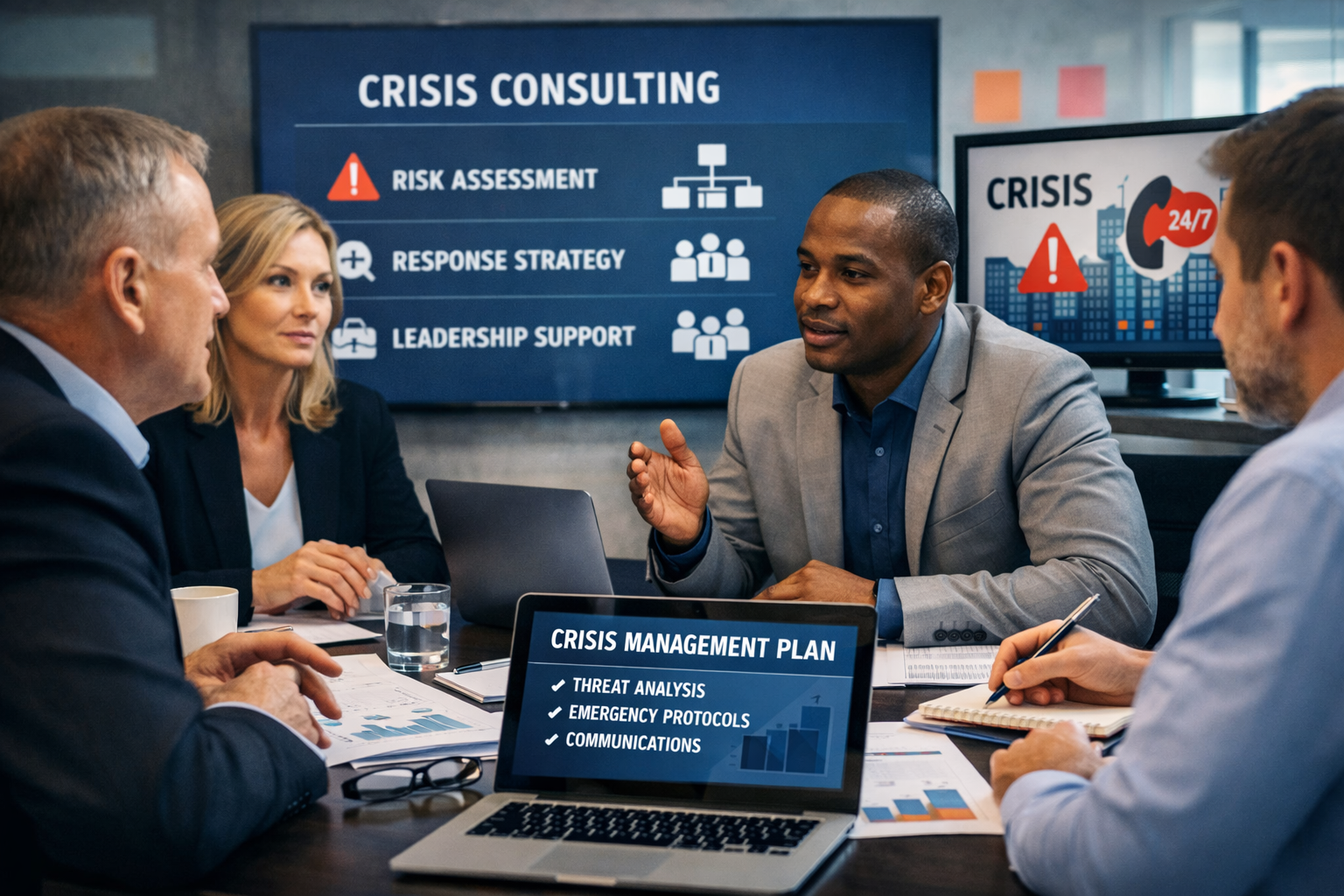
Crises rarely announce themselves clearly. Instead, they emerge from a combination of overlooked risks, unclear decision-making, and untested plans. When an organization faces a high-impact event, whether related to security, operations, or reputation, the outcome often depends less on the incident itself and more on how prepared leadership is to respond.
This is where a crisis consulting group becomes essential.
Crisis consulting groups provide specialized guidance to help organizations anticipate threats, prepare leaders, and manage complex situations under pressure. Rather than focusing solely on physical security or emergency response, crisis consultants address the broader challenge of organizational readiness before, during, and after a crisis.
What Is a Crisis Consulting Group?
A crisis consulting group is an advisory team that helps organizations reduce risk exposure and improve their ability to respond effectively to critical incidents. Their role spans prevention, preparedness, response, and recovery.
Unlike traditional security providers, crisis consulting groups focus on:
- Strategic risk identification
- Leadership decision-making
- Crisis planning and coordination
- Organizational resilience
- Post-incident improvement
Their work supports executives and leadership teams by helping them understand how decisions, communication, and structure impact outcomes during high-stress situations.
Why Crisis Consulting Is Different From Traditional Security Services
Many organizations invest heavily in physical security measures such as cameras, access control systems, and guards. While these tools are important, they do not address how an organization functions during disruption.
Traditional security services typically focus on:
- Protecting facilities and assets
- Monitoring and enforcement
- Incident detection
Crisis consulting groups focus on:
- What happens when systems fail
- How leaders make decisions under pressure
- How information flows during an incident
- How teams coordinate across departments
This strategic layer is often missing until an incident exposes it.
The Role of Crisis Consulting Before a Crisis Occurs
The most valuable crisis consulting work happens before an incident ever takes place. Proactive engagement allows organizations to identify vulnerabilities and address them without the pressure of an active emergency.
Pre-crisis consulting often includes:
- Risk and vulnerability assessments
- Crisis scenario development
- Tabletop exercises for leadership
- Review of policies and response plans
- Clarification of roles and authority
These efforts help organizations move from reactive planning to intentional preparedness.
Crisis consulting also complements a facility security assessment by ensuring that identified risks are tied to clear response strategies and leadership accountability.
👉 Learn more about identifying facility-level risks in our guide to facility security assessment:
Crisis Consulting During an Active Incident
When a crisis unfolds, leaders are often required to make rapid decisions with incomplete information. Stress, uncertainty, and time pressure increase the likelihood of errors.
During an active incident, a crisis consulting group may assist by:
- Helping leadership assess evolving conditions
- Structuring decision-making processes
- Coordinating communication across teams
- Reducing confusion and role overlap
- Preventing escalation and secondary failures
Their role is advisory—not operational—but this external perspective can be critical in maintaining clarity and focus during chaotic situations.
Crisis Consulting and Situational Awareness
Crisis consulting groups rely heavily on situational awareness. While situational awareness focuses on recognizing emerging threats, crisis consulting helps organizations respond effectively once those threats escalate.
Together, they allow organizations to:
- Detect warning signs earlier
- Escalate concerns appropriately
- Activate response plans sooner
- Maintain alignment across leadership and teams
Many crisis consulting engagements uncover situational awareness gaps that were previously invisible, such as communication breakdowns or unclear escalation thresholds.
When Should an Organization Engage a Crisis Consulting Group?
Organizations often wait until after a major incident to seek crisis consulting support. By that point, damage has already occurred.
Engaging a crisis consulting group is especially valuable when:
- Leadership teams lack crisis experience
- Facilities operate in high-risk environments
- Past incidents revealed coordination issues
- The organization is growing or restructuring
- Crisis plans exist but have never been tested
Early engagement allows organizations to build resilience without disruption.
Crisis Consulting as a Long-Term Risk Management Strategy
Crisis consulting should not be treated as a one-time exercise. Threats evolve, organizations change, and assumptions become outdated.
Ongoing crisis consulting support helps organizations:
- Adapt to new risks
- Improve leadership confidence
- Reduce response time
- Strengthen cross-department coordination
- Learn effectively from incidents and near-misses
Guidance from the U.S. Department of Homeland Security emphasizes preparedness, coordination, and informed decision-making as core principles of effective crisis management—principles that align closely with crisis consulting best practices.
Crisis consulting groups provide a critical bridge between planning and execution. By focusing on leadership, decision-making, and coordination, they help organizations prepare for uncertainty and respond more effectively when it matters most.
When combined with facility security assessments and situational awareness, crisis consulting becomes a powerful layer of defense—supporting prevention, preparedness, and recovery across the entire organization.